JUNIOR POLICIES
Policies
Our policies and plans set the strategic direction for the club and the expectations of our community. We are proud to be Good Sports accredited.
Read our policies
COACHES
• Respect the rights and worth of every person regardless of their gender, ability, cultural background or religion.
• Be reasonable in your demands on players’ time, energy and enthusiasm.
• Avoid over-playing the talented players, the “just average” players need and deserve equal time.
• Remember that players participate for fun and enjoyment.
• Ensure that equipment and facilities meet safety standards and are appropriate to the age and ability of the players.
• Take into consideration the maturity level of the players, when scheduling and determining the length of practice times and competition.
• Develop team respect for the ability of opponents as well as for the judgement of officials and opposing coaches.
• Follow the advice of a physician when determining when an injured player is ready to recommence training or competition.
• Keep yourself informed of the sound coaching principles and the principles of growth and development of players.
• Create opportunities to teach appropriate sports behaviour as well basic skills.
• Ensure that skill learning and appropriate sports behaviour have priority over highly structured competitions for young players.
• Help players understand the responsibilities and implications of their freedom to choose between fair and unfair play.
• Wherever practical, avoid unaccompanied and unobserved one on one activity (when in a supervisory capacity or where a power imbalance will exist) with people under the age of 18 years.
• All coaches will adhere to accreditation standards as set down by the EFL.
ADMINISTRATORS/OFFICIALS
• Respect the rights and worth of every person regardless of their gender, ability, cultural background or religion.
• Ensure that equal opportunities for participation in sports are made available to all players, regardless of ability, size, shape, sex (for females under 14), age, disability or ethnic origin.
• Ensure that rules, equipment, length of games and training schedules take into consideration the age, ability and maturity level of participating players.
• Ensure that adequate supervision is provided by qualified and competent coaches and officials capable of developing appropriate sports behaviour and skill technique.
• Remember that players participate for enjoyment and play down the importance of rewards.
• Provide clinics aimed at improving the standards of coaching and officiating, with an emphasis on appropriate behaviour and skill technique.
• Ensure that parents, coaches, sponsors, physicians and participants understand their responsibilities regarding fair play.
• Modify rules and regulations to match the skill level of players and their needs.
• Condemn unsporting behaviour and promote respect for all opponents.
• Publicly encourage rule changes which will reinforce the principles of participation for fun and enjoyment.
• Ensure that your behaviour is consistent with the principles of good sporting behaviour.
• Make a personal commitment to keep yourself informed of sound officiating principles and the principles of growth and development of players.
PARENTS/SPECTATORS
• Respect the rights and worth of every person regardless of their gender, ability, cultural background or religion.
• Encourage players to participate, if they are interested.
• Encourage players to always participate according to the rules.
• Never ridicule or yell at a player for making a mistake or losing the game.
• Remember that players learn best from example. Applaud good plays by all teams.
• If you disagree with an official, raise the issue through the appropriate channels rather than questioning the official’s judgement and honesty in public.
• Support all efforts to remove verbal and physical abuse from sporting activities.
• Recognise the value and importance of volunteer coaches.
• Remember that children play organised sports for fun. They are not playing for the entertainment to spectators only, nor are they miniature professionals.
• Condemn the use of violence in any form, be it by spectators, coaches, officials or players.
• Encourage players to follow the rules and the officials’ decisions.
• Demonstrate appropriate social behaviour by not using foul language, harassing players, coaches or officials.
PLAYERS
• Respect the rights and worth of every person regardless of their gender, ability, cultural background or religion.
• Play by the rules.
• Never argue with an official. If you disagree, discuss the matter with your coach.
• Control your temper. Verbal abuse of officials or other players, or provoking an opponent is not acceptable.
• Work equally hard for yourself and/or for your team. Your team’s performance will benefit, so will you.
• Be a good sport. Applaud all good plays whether they be by your team, opponent or the other team.
• Treat all players as you would like to be treated. Do not interfere with, bully or take unfair advantage of another player.
• Co-operate with your coach, team mates and opponents. Without them there would be no competition.
• Play for the “fun of it” and not just to please parents and coaches.
• Avoid using derogatory language.
Note: Codes of Conduct are part of the National Football Policy provided by the Australian Football League.
Rationale
Kilsyth Junior Football Club recognises that:
• Environmental (second-hand) tobacco smoke is a health hazard and that non-smokers should be protected from it.
• Role modelling can have a significant impact upon the junior members of the club.
• Smoke free areas make smoking less visible and less socially acceptable.
• Smoke free areas support smokers who are trying to quit as well as reduce their overall cigarette consumption.
• Outdoor smoke free areas help to reduce the amount of cigarette butt litter (reducing clean-up costs, fire risk and children’s health risk due to swallowing discarded butts).
• Smoke free environments are advantageous in attracting new members as well as positively promoting the club in the community.
New Victorian legislation (Tobacco Amendment Act 2013) also bans smoking within 10 metres of a sporting venue that is an outdoor public place during underage (U18) competitions, training or practice sessions or any break or interval during these underage activities.
Accordingly, the following policy shall apply to all members, administrators, officials, coaches, players, spectators, visitors and other volunteers and/or or staff of the club.
General
• Cigarettes and other tobacco products will not be sold, including from vending machines, at any time at or by the club.
• Coaches, players, officials and volunteers will refrain from smoking while involved in an official capacity for the club, on and off the field.
• No images of club volunteers, members, officials, coaches and players smoking at club-related activities are to be placed on social media.
Smoke Free Areas
The Kilsyth Junior Football Club requires the following areas of the club’s facility and surrounds to be smoke free:
• All indoor areas
• All outdoor playing/training areas
• All spectator areas (standing and seated, covered and uncovered)
• All canteen, catering and eating and drinking areas
• All areas where children are present.
Smoke free areas will be signed (where possible) and promoted in club materials.
Functions
• Club functions, including social and fundraising events and meetings, held at club facilities are to be smoke free.
• Club functions, including social and fundraising events and meetings, held away from club facilities are to be smoke free wherever possible.
• If provided, smokers may only smoke at outdoor designated smoking areas and are to dispose of cigarette butts safely before entering facilities.
Non-compliance
All club committee members will enforce the smoke free policy and any non-compliance will be handled according to the following process:
• Explanation of the club policy and the Victorian tobacco laws to the person/people concerned, including identification of the areas in which smoking is permitted
• Continued non-compliance with the policy should be handled by at least two committee members who will use their discretion as to the action taken, which may include asking the person/ people to leave the club facilities or function.
Policy Promotion
The club will promote the smoke free policy regularly by:
• Putting a copy of the policy in club newsletters and printed member/player information and on the website.
• Promoting positive smoke free messages through the club’s social media.
• Displaying a copy of the policy in the club social rooms.
• Periodic announcements to members at functions.
• Placing non-smoking signage in prominent locations both indoors and outdoors.
The club recognises the importance of educating club members, particularly players, of the benefits of implementing a smoke free policy and will endeavour to provide information to assist this process.
This policy provides the basis for the responsible use of alcohol by the Kilsyth Junior Football Club and is seen as fundamental to the aims of the club.
The club recognises the importance of holding a liquor licence, enabling it to generate income and hold social functions. In doing so however, we accept the responsibilities and expectations of the community in adhering to liquor licensing laws and the criteria of the Good Sports program.
To ensure the aims of the club are upheld and that alcohol is managed responsibly by the club and its members, the following requirements will apply when alcohol is served at the club or during a club function.
Serving Alcohol
Alcohol will be served according to the legal and moral requirements of the club’s Liquor Licence with the safety and wellbeing of patrons as the priority.
• The club maintains a current appropriate Liquor Licence
• Only RSA trained personnel will serve alcohol
• People under 18 will not serve alcohol
• The club does not encourage excessive or rapid consumption of alcohol
• When serving non pre-packaged alcohol, standard drink measures will be served at all times
• The club’s Liquor Licence and all legal signage will be displayed at the bar
• Names of RSA trained bar personnel will be displayed
• An incident register shall be maintained and any incident recorded
Intoxicated Patrons
• Drunk patrons will not be permitted to enter the premises
• Alcohol will not be served to any person who is drunk and/or behaving in an inappropriate or anti-social manner
• Bar personnel will follow RSA training procedures when refusing service
• Drunk patrons will be asked to leave the premises (after appropriate safe transport options are offered)
Underage Drinking
• Alcohol will not be served to persons aged under 18
• Bar personnel and committee members will ask for proof of age whenever necessary or whenever in doubt
• Only photo ID’s will be accepted as ‘proof of age’
Alcohol Alternatives
The club recognises that alcohol is not the only revenue stream available and actively encourages the sales of alternative products to that of alcohol.
• Tap water is provided free of charge (where available)
• One low-alcoholic drink and at least four non-alcoholic drink options are always available and are at least 10% cheaper than full-strength alcoholic drinks
• Substantial food is available when the bar is open for more than 90 minutes or more than 15 people are present
• The club will avoid using alcohol for player awards and fundraising prizes
Safe Transport
The club has a (separate) Safe Transport Policy that is reviewed regularly in conjunction with this Alcohol Management Policy.
Smoke-Free
The club has a (separate) Smoke Free Policy that is reviewed regularly in conjunction with this Alcohol Management Policy.
Club Trips
The club will monitor and ensure any club trips, particularly end of season player trips, strictly adhere to responsible behaviour and alcohol consumption in accordance with the principles of this policy and the aims of the club.
Non Compliance
All club committee members will enforce the alcohol management policy and any non-compliance, particularly in relation to Licencing Laws and will be handled according to the following process:
• Explanation of the club policy to the person(s) concerned, including identification of the section of policy not being complied with, and
• Continued non-compliance with the policy should be handled by at least two committee members who will use their discretion as to the action taken, which may include asking the person(s) to leave the club facilities or function
Committee Policy Management
The presence of committee members is essential to ensure the operation of the bar and compliance with this policy. At least two committee members who are RSA trained are required to be present at all club functions when the bar is open.
Key responsibilities of the duty committee members are to:
• Meet visiting police, cooperate and assist with any inquiries,
• Compliance in respect of persons under 18 years of age on premises,
• Recording any incidents in the incident register, and
• Ensuring strict compliance with all sections of this policy in accordance with legal requirements and the Good Sports program.
Policy Promotion
The Club will promote the alcohol management policy regularly by:
• Putting a copy of the policy in club communications, eg. newsletters, website and printed member/ player information,
• Displaying a copy of the policy in the club social rooms, and
• Periodic announcements to members at functions.
The Club recognises the importance of educating club members, particularly players, about the benefits of an alcohol management policy and will endeavour to provide information to assist this process.
The Club will actively participate in the Australian Drug Foundation’s Good Sports program with an ongoing priority to maintain Level 3 accreditation.
Our commitment
Electronic communication is essential for sharing club news and information with our members. Our communication will be timely, appropriate and related to club business.
What we will do
We use a range of electronic tools to communicate with our members.
Our communication will protect members’ privacy, maintain clear boundaries and ensure that bullying and harassment does not occur.
A webmaster will be appointed to provide accountability and control over material published on our club’s website and any related discussion groups or social media websites, such as Facebook, YouTube or Twitter.
Website / Club App
• Our website/app will include current information on competitions, social events, committees, policies, constitution, rules and by-laws.
• No offensive content or photos will be published.
• If we intend to publish a photo of a child, we will first seek permission from his or her parents and take care not to provide identifying information.
• We will seek feedback from members to improve the information available on the site.
SMS and email
Committee members, coaches and team managers may use SMS and email to provide information about competition, training, club-sanctioned social events and other club business, however:
• SMS messages should be short and about club/team matters
• email communication will be used when more information is required
• communication involving children will be directed through their parents.
Social media websites
• We treat all social media postings, blogs, status updates and tweets as public ‘comment’.
• Postings (written, photos or videos) will be family-friendly and feature positive club news and events. (Please refer to our guidelines regarding the use of images of children).
• No personal information about our members will be disclosed.
• No statements will be made that are misleading, false or likely to injure a person’s reputation.
• No statements will be made that might bring our club into disrepute.
• Abusive, discriminatory, intimidating or offensive statements will not be tolerated. Offending posts will be removed and those responsible will be blocked from the site.
What we ask you to do
We expect our members to conduct themselves appropriately when using electronic communication to share information with other members or posting material on public websites connected to the club.
Electronic communication:
• should be restricted to club matters
• must not offend, intimidate, humiliate or bully another person
• must not be misleading, false or injure the reputation of another person
• should respect and maintain the privacy of members
• must not bring the club into disrepute.
Coaches and others who work with children and young people must direct electronic communication through the child’s parents.
Non-compliance
Members may face disciplinary action for sending inappropriate electronic communication or posting online content or comments that harass, offend, intimidate or humiliate another member, as outlined in our member protection policy or code of conduct.
Under certain circumstances, cyber bullying (e.g. bullying that is carried out through an internet service such as email, a chat room, discussion group, instant messaging or website) is a criminal offence that can be reported to the police.
In addition, members who publish false or misleading comments about another person in the public domain (e.g., Facebook, YouTube or Twitter) may be liable for defamation.
Images of children
The Law
In Australia, generally speaking, there is no law restricting photography of people (including children) in public spaces as long as the images are not:
• indecent (such as ‘up skirt’ or ‘downblouse’ photographs taken covertly in change rooms or toilets)
• being used for voyeurism or made for the purpose of observing and visually recording a person’s genital or anal region
• protected by a court order (eg. child custody or witness protection)
• defamatory
• being for commercial purposes (person’s likeness is used to endorse or entice people to buy a product).
Photos of a child (including your own child) also contravene Criminal Codes and censorship laws if the child is photographed in a provocative or sexual manner.
Where a sporting event is held on a club’s private property, privately owned land, a school or council owned facilities, the owner of private property or venue is able to restrict, ban or require permission of photography anywhere in their venue (e.g. some council owned facilities will not allow mobile phones or cameras in change rooms or toilets). Where a sporting event is held on private property not owned by the organisers, it is good practice to determine a mutually agreed photographing policy.
If a person is taking photographs inappropriately (e.g. breaching the restrictions or ban in place for that private property or venue), then venue management can request the person to stop. If the person refuses, the police or security may be called to escort them off the property.
Strategies set down by Kilsyth Junior Football Club – Acquiring Images
• Do not allow photographers (professional photographers, spectators, fans, coaches or members of the media) unsupervised access to children.
• Ensure the coach informs any athlete and parent(s) if the coach wants to video the athlete as a tool to analyse and improve performance.
• Obtain permission from the child’s parent/guardian prior to taking the images of a child or young person. Ensure that all concerned are aware of the way in which the image is to be used and how long the image will be displayed.
• Obtain the consent of parent /guardian and their agreement to be present before approving photo/video sessions outside the event venue or at the home of a child. Where possible, have the photo taken at the event venue.
• Provide details of who to contact within the club or organisation if concerns or complaints of inappropriate behaviour in taking images or content are raised. Ensure that the contact person understands the application of relevant legislation and policies.
Strategies set down by Kilsyth Junior Football Club – Displaying images
• If an image is used avoid naming the child. If this is not possible avoid using both a first name and surname.
• Avoid displaying personal information such as residential address, email address or telephone numbers if images are being posted on websites or distributed in publications.
• Do not display information about hobbies, likes/dislikes, school, etc as this information has the potential to be used as grooming tools by paedophiles or other persons.
• Only use appropriate images of the child, relevant to the sport or activity, and ensure that the athlete/child is suitably clothed. Images of athletes participating in sports or activities that involve minimal clothing (e.g. swimming and gymnastics) or unusual body positions/poses could potentially be misused.
• Reduce the ability for direct copying of pictures from a website to another source (i.e. disable the ‘right mouse click’ function).
• Clearly outline in a written contract to photographers who are contracted or paid to take photos, who will retain the images taken, include arrangements made for negatives, digital file and proofs and outline any restrictions for use and sale.
• Provide details of who to contact and what to do if concerns or complaints of inappropriate image use are raised.
This policy aims to provide a basis for the responsible use and/or non-use of alcohol by the Kilsyth Junior Football Club and to avoid any incidents as people travel to or from the club and its events.
The Club understands and accepts its responsibility to the safety of our members and friends. The following requirements will apply when alcohol is served, either at the club or during a club function.
• Bar staff shall encourage members and visitors to make alternate safe transport arrangements if they are considered to exceed .05 blood alcohol concentration (or .00 if probationary driver)
• Telephone calls will be made free of charge to arrange a taxi or other transport
• Contact telephone numbers for taxi services will be clearly displayed
• Bar servers will be provided non-alcoholic drinks and bar food free of charge by the club (only for club bar staff)
• Committee will pre-order taxis to arrive at the venue at the conclusion of the function.
Recruitment and Selection Policy
Reviewed: September 2017
Objective: Policy is to provide a club position on the approach to recruitment and selection of players at Kilsyth Junior Football Club
Key Outcomes:
- Increase total number of players at Kilsyth Junior Football Club
- Improve the playing standard at Kilsyth Junior Football CLub
- Reduce the loss of players going to play a higher standard of football
- Deliver players into Senior Club with capacity to play Senior Football at Kilsyth
- Provide clarity of approach for players, parents and coaches
Background information:
- For safety & developmental reasons, all players are to register and play in their age group. Any player who has played in an older age group will not automatically be permitted to play in the subsequent year. Players will be only allowed to play up an age group in special circumstances at the discretion of the committee.
- Age groups have been defined into 3 categories; non-competitive (Under 8-10), development (Under 11-13) and competitive (Under 14-17).
- EFL guidelines allow that teams have a total of 26 players registered in each team for U8-U15. Under 17 can register a total of 30 players but only 24 can be selected each week with others being rostered off as required.
- Players are to be financial members to be eligible for selection.
Under 8-10
- Development approach with focus on skills and working together. PLayers play the same amount of game time and are provided with opportunity to play all positions.
- Registration to remain open 3 weeks from the commencement of the season. At that time we can determine total number of players and teams
- Club will take a first in approach to registration and selection
Under 11-13
- Development remains the key outcome though there is a move towards the competitive environment. Players continue to play the same game time though positions may become selective into Under 13 age group.
- Registration to remain open 3 weeks from the commencement of the season. At that time we can determine total numbers of players and teams.
- Club will undertake a review of the playing list in order to select based on club engagement, teamwork, effort and capability.
- Selection of finals will be based on providing best opportunity for success.
Under 14-17
- Improve the playing standard of teams with a view to select sides and playing positions based on capability.
- Registration to remain open 3 weeks from the commencement of the season. At that time we can determine total numbers of players and teams.
- Selection of finals will be based on providing best opportunity for success
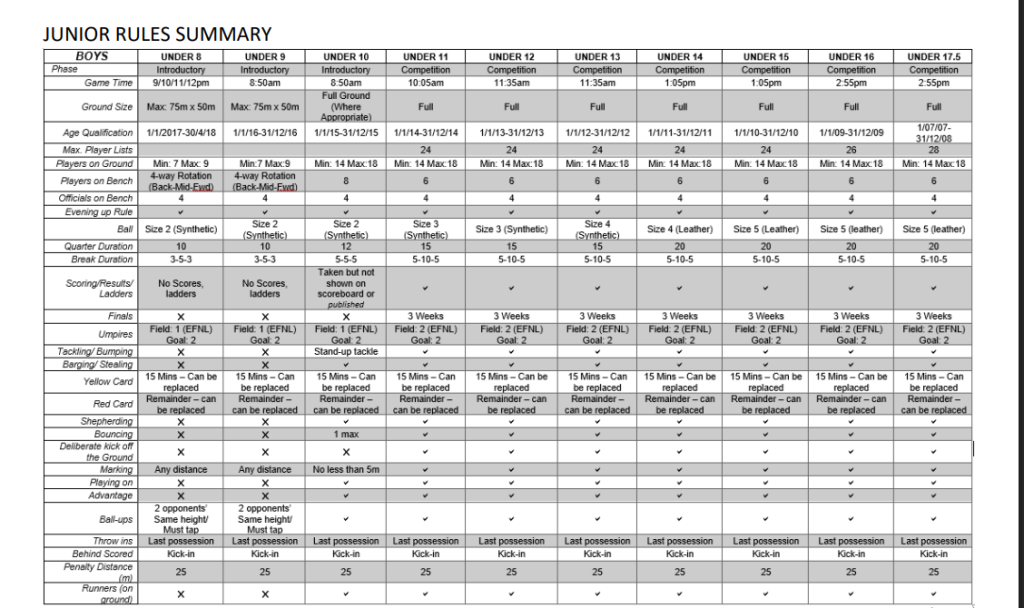
Junior Rules Summary
2025 EFNL Junior Competition Fixture Dates
Date Round
Sunday 6 April 1
Sunday 13 April BYE
Sunday 20 April BYE
Sunday 27 April 2
Sunday 4 May 3
Sunday 11 May 4
Sunday 18 May 5
Sunday 25 May 6
Sunday 1 June 7
Sunday 8 June BYE
Sunday 15 June 8
Sunday 22 June 9
Sunday 29 June 10
Sunday 6 July 11
Sunday 13 July BYE
Sunday 20 July 12
Sunday 27 July 13
Sunday 3 August 14
Sunday 10 August Week 1 Finals
Sunday 17 August Week 2 Finals
Sunday 24 August Junior Grand Final Day
2025 EFNL Junior Interleague Fixture Dates
Date Round
Wednesday 28 May 1
Saturday 7 June 2
Monday 9 June 3
5
MATCH DAY INFORMATION
Please note:
– The clock will NOT stop for any reason (including if a stretcher is called).
– Clubs will need to be flexible with starting times during the home and away season.
– Start times for finals may vary depending on ground availability and the finals system. Clubs will be notified
of timings on a week-by-week basis during the final series.
GRADE START TIME QTR
DURATION
1⁄4 QTR
BREAK
HALF
TIME
BREAK
3⁄4 QTR
BREAK TIME ON
Under 8 Mixed 9am/10am/11am 10 mins 5 mins 5 mins 5 mins No
Under 8 Girls 9am/10am/11am 10 mins 5 mins 5 mins 5 mins No
Under 9 Mixed 8:50am 10 mins 5 mins 5 mins 5 mins No
Under 10 Mixed 8:50am 12 mins 5 mins 5 mins 5 mins No
Under 10 Girls 10:05am 12 mins 3 mins 5 mins 3 mins No
Under 11 Mixed 10:05am 15 mins 5 mins 10 mins 5 mins No
Under 12 Girls 10:05am 15 mins 5 mins 10 mins 5 mins No
Under 12 Mixed 11:35am 15 mins 5 mins 10 mins 5 mins No
Under 13 Mixed 11:35am 15 mins 5 mins 10 mins 5 mins No
Under 14 Girls 11:35am 15 mins 5 mins 10 mins 5 mins No
Under 14 Mixed 1:05pm 20 mins 5 mins 10 mins 5 mins No
Under 15 Boys 1:05pm 20 mins 5 mins 10 mins 5 mins No
Under 16 Girls 1:05pm 17 mins 5 mins 10 mins 5 mins No
Under 16 Boys 2:55pm 20 mins 5 mins 10 mins 5 mins No
Under 17.5 Boys 2:55pm 20 mins 5 mins 10 mins 5 mins No
Under 18 Girls 2:55pm 17 mins 5 mins 10 mins 5 mins No
6
UNIFORMS & EQUIPMENT
Jumpers
All teams in all age grades (inclusive), shall wear their registered club playing jumper at all home and away
games.
Jumper Clashes
Where two clubs compete in the same division and those clubs’ colours are the same or similar and are
drawn to compete against one another, the away club must change its jumper.
In the event of teams whose colours are the same or similar meetings in finals, the club finishing higher on
the ladder at the completion of the season will retain its jumper.
A list of recognised jumper clashes will be published on the website prior to the start of each season.
Shorts
All teams in all age grades (inclusive), shall wear their registered club-coloured shorts at all home and away
games.
Undergarments
Undergarments (i.e., compression skins) that extend beyond the length of the jumper are not permitted to
be worn. Exceptions to this rule shall be applied under medical and/or religious grounds. For clarification
long sleeve playing jumpers are allowable under this rule.
Undergarments such as bicycle/lycra shorts that extend below the line of the uniform must be beige or
black in colour and not extend below the knee. Exceptions to this rule shall be applied under medical
and/or religious grounds.
Players in non-competitive age groups are permitted to wear either long sleeve playing jumper or lycra
top/tights, in black or jumper colour, underneath their playing uniform. Should adverse weather conditions
permit, players in all junior grades shall be permitted to wear undergarments per the above.
Socks
The teams of each club shall wear their registered club-coloured socks, incorporating the EFNL logo.
Gloves, Helmets and Protective Equipment
Gloves and helmets must be approved by EFNL and manufactured for use in Australian Rules Football in
official EFNL matches.
A player must have approval from the EFNL to wear any protective equipment in a match. If there is any
doubts regarding a players’ protective equipment, clubs are advised to contact the EFNL Junior Football
Manager or General Manager – Football Operations.
Mouth Guards
Mouthguards are strongly recommended across all divisions and age groups, however not compulsory.
Hair
Hair extending past the shoulders should be appropriately tied up for safety for all participants.
7
Jewellery
The wearing of any form of jewellery is prohibited. This includes all piercings, taped or otherwise.
Umpires have the authority to warn/yellow card/red card any breaches of this rule.
Nails
Nails should be kept short for the safety of both players and opponents.
Boots
No players are permitted to wear metal stops, rugby cleats or metal tipped stops in any official EFNL
match.
8
FOOTBALL SIZE/REQUIREMENTS
Age Group Type Size
Under 8 Mixed + 8 Girls Synthetic 2
Under 9 Mixed Synthetic 2
Under 10 Mixed + 10 Girls Synthetic 2
Under 11 Mixed Synthetic 3
Under 12 Mixed + 12 Girls Synthetic 3
Under 13 Mixed Synthetic 4
Under 14 Girls Synthetic 4
Under 14 Mixed Leather (Match) 4
Under 15 Boys Leather (Match) 5
Under 16 Girls Leather (Match) 4
Under 16 Boys Leather (Match) 5
Under 17.5 Boys Leather (Match) 5
Under 18 Girls Leather (Match) 4
Where the condition of the ground is such that the use of a yellow ball is more suitable than a red ball,
yellow balls may be used at the agreement of both Team Managers. Should the Team Managers fail to
agree, the umpire shall determine the colour of ball to be used.
Yellow balls shall be used in junior matches where the game is to be played during twilight or at night.
INSURANCE
The Eastern Football Netball League in conjunction with BJS Insurance Brokers Pty Ltd, the league’s
insurance broker and risk adviser, has arranged insurance coverage for all their affiliated member clubs,
officials, coaches, umpires, voluntary workers, and players. The link for all EFNL insurance information is
https://www.eflinsurance.com.au/
The program provides competitively broad protection across the following areas:
• Public Liability including Professional Indemnity
• Group Personal Accident cover for Capital Benefits, Non-Medicare Medical Expenses and Loss of
Income
• Association Liability
Regarding Personal Accident coverage; the schedule of benefits should be considered as basic and entry
level.
The Eastern Football Netball League encourages all players and others covered by this policy to take out
private health insurance, furthermore it is advisable that all players have Ambulance Victoria Membership
to cover medical transport costs.
9
REGISTRATIONS
PlayHQ
For online video tutorials on your Play HQ Dashboard, click here.
For an online video tutorial on how to create your Play HQ registration forms, click here.
To register as a Player on PlayHQ go to this link to find your Club’s registration form.
TEAM SHEETS on PLAYHQ
1. To create a team sheet for a match you need to be registered as a Team Manager and given access
to your Team by a Club Admin.
2. Log in to your PlayHQ account at this link. Click on your Name in the top right hand corner of the
screen, click on My Account, click on Teams. You will now see which Teams you have access to
manage.
3. Click on the Team and click on the match you would like to create a team sheet for. Click Manage.
From here you can select your players, edit jumper numbers and select your team officials.
To view the AFL Community Football Team Manager PlayHQ User Guide click here.
MATCH DAY PAPERWORK
Team Sheets
Any player not allocated to the printed team sheet MUST be hand written on the team sheet and include
the players full name and jumper number.
Any player who was allocated to the printed team sheet and did not play MUST be crossed out on the
team sheet.
Junior team sheets MUST be handed to the umpires no later than half time by the Team Manager.
Junior team sheets are not required to be exchanged between clubs.
Clubs must review the online team sheet for accuracy and adjust as appropriate by 5:00pm Monday
following the game.
Results
Home teams are responsible for entering accurate match results into PlayHQ at the conclusion of matches. This
includes quarter by quarter scores.
All teams are responsible for entering their own player goal kickers. Best players are not permitted to be entered.
10
FIXTURES
In 2025, the league will publish junior fixtures in the following order:
FIXTURE AMENDMENT REQUESTS
Rounds 1 & 2 (Grading)
Clubs have until 5pm, Wednesday 2
nd April 2025 to request any fixture amendments for approval. This can
include the following:
• Venue changes
• Oval changes
• Time changes
• Assist with Umpire Appointments
From 12pm, Thursday 3rd April 2025, the Round 1 and 2 fixtures will be deemed FINAL.
From this time, it is required that all Clubs review their Round 1 and 2 fixtures to check any changes that
were made.
If any further changes are required after this time, all affected Clubs will be notified by the league.
Rounds 3 and 4 (Grading)
Clubs have until 9am, Thursday 1
st May 2025 to request any fixture amendments for approval. This can
include the following:
• Venue changes
• Oval changes
• Time changes
• Assist with Umpire Appointments
From 12pm, Thursday 1
st May 2025, the Round 3 and 4 fixtures will be deemed FINAL.
From this time, it is required that all Clubs review their Round 3 and 4 fixtures to check any changes that
were made.
If any further changes are required after this time, all affected Clubs will be notified by the league.
Round(s) Release Date
1 & 2 (Grading) Monday 31 March
3 & 4 (Grading) Wednesday 30 April
5 – 14 Thursday 15 May
11
Rounds 5 and 6
Clubs have until 12pm, Thursday 15th May 2025 to request any fixture amendments for approval. This can
include the following:
• Venue changes
• Oval changes
• Time changes
• Assist with Umpire Appointments
From 5pm, Thursday 15th May 2025, the Round 5 and 6 fixtures will be deemed FINAL.
From this time, it is required that all Clubs review their Round 5 and 6 fixtures to check any changes that
were made.
If any further changes are required after this time, all affected Clubs will be notified by the league.
Rounds 7 to 14
For Rounds 7 to 14, the below excerpt from the EFNL By-Laws will apply for fixture changes.
Clubs desiring to conduct matches on a day or time other than that published by the league in the official
fixture may do so providing the following requirements have been satisfied:
(i) that all appropriate licences and permissions to conduct the game have been received and
copies forwarded to the EFNL Office prior to the game.
(ii) that 10 business days’ notice is forwarded to the EFNL office indicating times of commencement
of all games and any alterations of venues to the published fixture.
(iii) that 10 business days’ notice in writing requesting approval from the GM-FO or Junior Football
Manager that the fixture be altered is forwarded to the EFNL office from each club.
(iv) the league reserves the right to alter fixtures with limited notice where necessary (i.e. umpire
appointments/ ground scheduling).
KEY FIXTURE INFORMATION
– The Home Club reserves the right, in conjunction with EFNL approval, to make changes to their
fixtures and amend game times one side of the age groups usual time slot
o E.g. U14 Mixed can be moved to either the 11:35am or 2:55pm time slot
– This time slot change is often dictated by either the home Club or the EFNL Umpiring Manager to
manage venue clashes and/or umpiring appointments.
12
YELLOW/RED/WHITE CARDS
Yellow Cards
IF an umpire believes that a player has committed an offence, they will be shown a yellow card.
IF a player is shown a yellow card, the player is to be sent off for a total of 15 playing minutes. The player
can be replaced on the ground at the time, however is ineligible to take the field until the 15 playing
minutes have passed. It is the job of the team manager to ensure a total of 15 minutes has elapsed.
All yellow cards are recorded by the league, with clubs notified in the days following the match.
IF a player receives their second (2) yellow card in the same season, they will receive a one (1) match
suspension. The player will serve a one (1) match suspension for every yellow card received for the
remainder of the season.
Yellow card offences can include, but are not limited to:
– Abuse
– Dangerous Tackle
– Failing to leave the area when directed
– Metal Studs
– Piercings not removed
– Rough conduct
– Striking or attempting to strike
– Umpire Abuse
– Wrestling
– Any other act that the field umpire believes is not within the spirit of the game.
Red Cards
IF an umpire believes that a player has committed a serious offence, they will be shown a red card.
IF a player is shown a red card, the player is to be sent off for the remainder of the match. The player can
be replaced on the ground at the time by a player on the interchange. It is the job of the team manager to
ensure that the player who has been shown a red card does not participate in the remainder of the match
All red cards are recorded by the league, with clubs notified in the days following the match.
IF a player receives a red card in the season, they will receive a one (1) match suspension effective
immediately. The player will serve a one (1) match suspension for every yellow or red card received for the
remainder of the season.
Yellow card offences can include, but are not limited to:
– Receiving a second yellow card in the same match
– Intentionally, recklessly or negligently making contact or striking an umpire
– Attempting to make contact or striking an umpire
– Intentionally, recklessly or negligently kicking another person
13
– Any act of misconduct if the umpire is of the opinion that the act constituting misconduct is serious
in nature
White Cards
Where unacceptable behaviours are emanating from the coaching box, a three-phase system will be
undertaken by the field umpire(s) via the use of white and red cards to stop such behaviours in real time.
Three Phase System:
1. Phase 1 – A warning (White Card Shown)
2. Phase 2 – Another warning, free kick and 25m penalty (White Card Shown)
3. Phase 3 – Head Coach reported and removed from the game, free kick and 25m penalty (Red Card
Shown)
IF misconduct is of a serious nature, the field umpire(s) may choose to show a red card at any stage.
The head coach holds the responsibility of the white card. Regardless if it is an assistant coach, trainer,
runner, injured player or spectator around the box, if a white card is shown the head coach is held
accountable.
It is important that only officials which are permitted to be in the coaching area are properly attired with
armbands (No Injured Players).
The league strongly advises that the Head Coach keeps the areas surrounding their coaching box free from
parents and spectators to avoid any indiscretions.
All white cards handed out within a season are recorded at league level.
As white cards are received, the following procedure is followed at league level:
Coach receives 1st White Card for Season
➢ Club is alerted and potentially fined
Coach receives 2nd White Card for Season
➢ Club is alerted and fined
➢ Coach must complete education module before coaching again
Coach receives 3rd White Card for Season
➢ Club is fined and Coach receives a 1 match penalty
➢ Coach receives citation with the AFL and has potential to lose coaching accreditation
14
REPORTABLE OFFENCES
In all sanctioned EFNL matches umpires have powers under the AFL Laws of Australian Football to report
any player for a breach.
In the event of any reportable offence taking place during the progress of any official match or on the day
of the match, the field umpire(s) shall have the power to report players or officials in respect of the
offence.
Should a player be reported during a game the following process will take place:
1. ONLY the Team Manager is permitted to attend the umpire’s rooms.
• NO other team officials, players or parents are permitted in the umpire rooms.
2. The field umpire(s) will then provide both team managers a copy of the report.
• Depending on the level of severity of the offence the umpire may choose to either offer a
set penalty OR direct the matter straight to the tribunal.
• Once the Team Manager has been given a copy of the report, no further action is required
on game day.
• Team Managers should give the report sheet to their Club Secretary or other Executive
member as soon as possible.
3. IF a set penalty has been offered, the Clubs will have until Monday 12pm to advise the EFNL Junior
Football Manager if the set penalty has been accepted.
• If communication has not been made to the EFNL Junior Football Manager by the above
deadline, it will be assumed the set penalty has been accepted.
• If Clubs choose to NOT accept the set penalty, the report will be heard at a tribunal hearing.
All affected Clubs will be notified with further details.
4. IF the officiating umpire has directed the matter directly to the tribunal ALL affected Clubs will be
communicated to with further details.
15
TRIBUNAL
All details regarding hearings at the Tribunal will be communicated to ALL affected parties once confirmed.
Tribunal hearings will be held on Tuesday evenings at EFNL House.
If a Club chooses to challenge a set penalty the Club will be subjected to a $250 fine if the challenge is
unsuccessful.
Successful challenges do not incur any fine.
We require all parties involved in the report (charged player, witness player and umpire) to attend the
tribunal. Each of these parties may be represented by an advocate. The witness player can also be
represented by an advocate. We strongly suggest that the advocate is not a relation of the player.
INVESTIGATIONS
If an umpire does not view or does not report an incident that may be perceived as reportable, the
aggrieved club may lodge a request for investigation with the EFNL Junior Football Manager by no later
than 4:00pm on Wednesday. If an investigation is requested the Club will be subject to a $350 bond.
The League will appoint an independent investigator to review the matter. This will include interviewing all
parties involved and any witnesses present. Once this process is complete the independent Investigator
will advise the EFNL Junior Football Manager of their findings. The EFNL Football Manager will advise the
affected Clubs of the findings and will communicate any sanctions to be enforced.
16
MATCH DAY FOOTBALL OPERATIONS
MATCH DAY OFFICIALS
Team Officials
Role Age Dress (EFNL) WWCC Required
Coach Accreditation Red Armband Yes
Assistant Coach Accreditation Red Armband Yes
Team Manager N/A Blue Armband Yes
Runner 16+ Uniform/Bib Yes
Trainer/s 16+ Bib Yes
Drink Carrier Not Permitted
Match Officials
Roles Age Dress (EFNL) WWCC Required
Timekeeper 18+ N/A No
Umpire Escort 18+ Bib Yes
Goal Umpire 15+ Bib Yes
Boundary Umpire Not Permitted
TRAINER QUALIFICATIONS AND REQUIREMENTS
Under 8-13 Under 14-18 Validity
CPR – HLTAID009 Mandatory Mandatory Must be renewed every twelve months
Level 2 First Aid –
HLTAID011 Mandatory Mandatory Must be renewed every three years
Junior Sports Trainer
(Prerequisite – Current
HLTAID009 &
HLTAID011)
Mandatory – Must be renewed every three years
Sports Trainer Level 1
(Prerequisite – Current
HLTAID009 &
HLTAID011)
– Mandatory Must be renewed every three years
17
TEAM OFFICIAL EXPECTATIONS
Team & Match Officials
Do Don’t
Fulfil your responsibilities and ask questions if
required
Interfere verbally or physically with players, officials or
spectators
Wear correct attire Be aggressive and loud from the sidelines
Conduct yourself in accordance with the League
(and club) code of conduct Interact with the umpire
Play by the Rules – know them and follow them Solely focus on winning
Be on time, be prepared and concentrate on
your role
Engage in unnecessary conversation not relevant to the
match
Coach (except for the coaches), barrack, comment on
play or any umpiring decisions
18
PLAYER AGE ELIGIBILITY
MIXED/BOYS
UNDER 8 1/01/2017 TO 30/04/2018
UNDER 9 1/01/2016 TO 31/12/2016
UNDER 10 1/01/2015 TO 31/12/2015
UNDER 11 1/01/2014 TO 31/12/2014
UNDER 12 1/01/2013 TO 31/12/2013
UNDER 13 1/01/2012 TO 31/12/2012
UNDER 14 1/01/2011 TO 31/12/2011
UNDER 15 1/01/2010 TO 31/12/2010
UNDER 16 1/01/2009 TO 31/12/2009
UNDER 17.5 1/07/2007 TO 31/12/2008
GIRLS
UNDER 8 01/01/2017 TO 30/04/2018
UNDER 10 1/01/2015 TO 31/12/2016
UNDER 12 1/01/2013 TO 31/12/2014
UNDER 14 1/01/2011 TO 31/12/2012
UNDER 16 1/01/2009 TO 31/12/2010
UNDER 18 1/01/2007 TO 31/12/2008
19
EVENING UP
Less than 20 available players (16-19 players available)
• Club can determine to play a 16 per side match.
• Must advise league (where possible) to ensure all clubs and umpires are aware.
• When playing 16 per side, the ground setup must be:
– 5 Forwards
– 6 Midfielders (1x Ruck, 3x Mid, 2x Wing)
– 5 Defenders
Less than 18 available players (14-17 players available)
• Club can determine to play a 14 per side match.
• Must advise league (where possible) to ensure all clubs and umpires are aware.
• When playing 14 per side, the ground setup must be:
– 5 Forwards
– 4 Midfielders (1x Ruck, 3x Mid, 0x Wing)
– 5 Defenders
The league strongly advises that clubs have taken all possible actions to ensure an even-up is not required.
As a result, it is requested that all clubs contact the league if there is the potential that an even-up is
required so the league can advise the best action plan for that weekend.
20
MOVEMENT BETWEEN JUNIOR TEAMS
MOVEMENT OF PLAYERS BETWEEN TEAMS AND AGE GROUPS – JUNIORS
All players in the under 8 to 18 grades (inclusive) may play out of their registered age group. However, no
player may:
• Play more than two years above his/her registered age group. As an exception to this rule Under 15
boys may fill-in, if necessary, in Under 17.5’s.
• Play more than three (3) games out of his/her registered age group in any one season, unless
approved by the Junior Manager.
The first team a player plays his/her fourth (4th) match in is the only team they can qualify for finals in.
Once a player has qualified in an age group, they are limited to three (3) matches in a higher age group.
Unless approved by the Junior Manager they cannot move down to a lower age group.
Under 17.5/ Under 18 Girls
All players in Under 17.5 and Under 18 Girls grade may play out of their registered age group. However, no
player may:
• Play nine (9) or more games out of his/her registered age group in any one season.
• Play nine (9) or more games in the senior competition and participate in Junior Boys finals in that
season.
Players may qualify for finals in both Under 17.5/Under 18 Girls and Under 19.5/Seniors.
MOVEMENT OF PLAYERS WITHIN AGE GROUPS – JUNIORS
Under 11 to 16
Where a club fields more than one (1) team in the same age and grade a player is permitted to move
between teams. However:
• Once a player has played five (5) matches in the higher graded team, that player may not move to
the lower graded team for the remainder of the season.
• Players in the lower graded team are free to move to the higher graded team during home and
away matches.
• The first team a player plays five (5) matches in is the only team that player is eligible to represent
in the finals series.
• Where a bye is fixtured in the higher graded team, no player is permitted to move to the lower
graded team during the week of the bye.
• If a club with multiple teams in one age group forfeits a match, the forfeit should occur in the lower
rated team.
Where a club field’s more than one team (1) in the Under 17.5 competition, a player is permitted to move
between teams. However:
• Where a bye or split round is fixtured in the higher graded team, no player is permitted to move to
the lower graded team during the week of the bye.
21
• A player must play at least 3 matches for the respective team during the home and away season to qualify to
play in the finals series for that team.
• Any player playing more than 7 matches during the home and away season in the higher graded team is
ineligible to play with the lower graded team in the finals.
• A player is only permitted to play in the finals series for one of the clubs Under 17.5 teams. Unless an
‘exceptional circumstances’ submission is lodged by the club, which outlines the grounds for consideration
and is approved by the EFNL Administration.
• If a club with two teams in the Under 17.5 competition forfeits a match, the forfeit should occur in the lower
rated team.
• Prior to either team playing an official game, a list of 15 players who are only eligible to play in the higher
ranked team must be submitted to the EFNL Junior Manager (Under 17.5).
FINALS ELIGBILITY
To Participate in Finals Matches – (Applies to home and away matches only)
• Players must play (take to the field during the game) at least 3 matches with their Affiliated Junior
team in home and away matches to qualify to play in the final’s series for their junior club.
• Any player drafted by an AFL club, placed on an AFL or rookie list or included on an official VFL/W
list can, provided they have qualified under the rules, return to play with the EFNL in the finals in
the seniors and reserve grades only
• Any player that plays more than 50% of home and away games in any season in the VFLW is
ineligible to play EFNL Senior and Junior finals in that season.
• Any player that plays nine (9) or more games in any season in the Coates League Boys competition
is ineligible to play EFNL boys junior finals in that season.
• Any player that plays more than 50% (9 matches) of home and away games in any season in the
Coates League Girls competition is ineligible to play EFNL Girls junior finals in that season
• Any player that plays one (1) or more games in any season in the VFL/VFLW competition is ineligible
to play EFNL boys/girls junior finals in that season.
• A player may qualify for finals for both a clubs U17.5 team and U19.5 team.
22
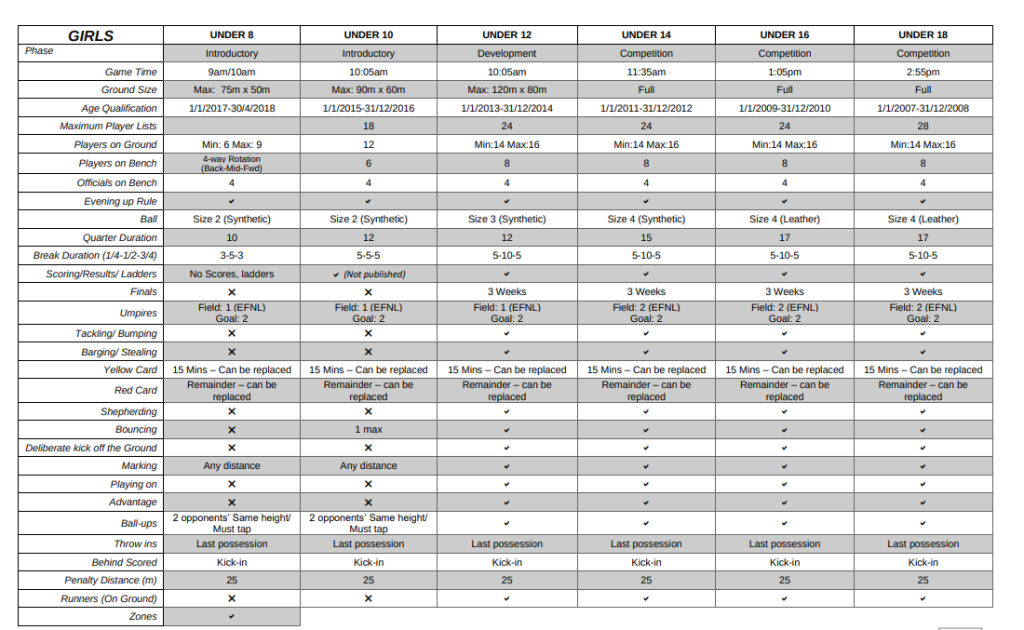
JUNIOR RULES SUMMARY
23
GIRLS UNDER 8 UNDER 10 UNDER 12 UNDER 14 UNDER 16 UNDER 18
Phase Introductory Introductory Development Competition Competition Competition
Game Time 9am/10am 10:05am 10:05am 11:35am 1:05pm 2:55pm
Ground Size Max: 75m x 50m Max: 90m x 60m Max: 120m x 80m Full Full Full
Age Qualification 1/1/2017-30/4/2018 1/1/2015-31/12/2016 1/1/2013-31/12/2014 1/1/2011-31/12/2012 1/1/2009-31/12/2010 1/1/2007-31/12/2008
Maximum Player Lists 18 24 24 24 28
Players on Ground Min: 6 Max: 9 12 Min:14 Max:16 Min:14 Max:16 Min:14 Max:16 Min:14 Max:16
Players on Bench 4-way Rotation
(Back-Mid-Fwd) 6 8 8 8 8
Officials on Bench 4 4 4 4 4 4
Evening up Rule
Ball Size 2 (Synthetic) Size 2 (Synthetic) Size 3 (Synthetic) Size 4 (Synthetic) Size 4 (Leather) Size 4 (Leather)
Quarter Duration 10 12 12 15 17 17
Break Duration (1/4-1/2-3/4) 3-5-3 5-5-5 5-10-5 5-10-5 5-10-5 5-10-5
Scoring/Results/ Ladders No Scores, ladders (Not published)
Finals 3 Weeks 3 Weeks 3 Weeks 3 Weeks
Umpires Field: 1 (EFNL)
Goal: 2
Field: 1 (EFNL)
Goal: 2
Field: 1 (EFNL)
Goal: 2
Field: 2 (EFNL)
Goal: 2
Field: 2 (EFNL)
Goal: 2
Field: 2 (EFNL)
Goal: 2
Tackling/ Bumping
Barging/ Stealing
Yellow Card 15 Mins – Can be replaced 15 Mins – Can be replaced 15 Mins – Can be replaced 15 Mins – Can be replaced 15 Mins – Can be replaced 15 Mins – Can be replaced
Red Card Remainder – can be
replaced
Remainder – can be
replaced
Remainder – can be
replaced
Remainder – can be
replaced
Remainder – can be
replaced
Remainder – can be
replaced
Shepherding
Bouncing 1 max
Deliberate kick off the Ground
Marking Any distance Any distance
Playing on
Advantage
Ball-ups
2 opponents’ Same height/
Must tap
2 opponents’ Same height/
Must tap
Throw ins Last possession Last possession Last possession Last possession Last possession Last possession
Behind Scored Kick-in Kick-in Kick-in Kick-in Kick-in Kick-in
Penalty Distance (m) 25 25 25 25 25 25
Runners (On Ground)
Zones
24
CLUB RESOURCES
KEY JUNIOR EFNL POLICIES
Can be found via the below link:
https://www.efnl.org.au/by-laws-and-rules
AFL CLUB HELP & POLICIES
AFL policies and resources can be found via the below link:
https://play.afl/learning-resources/clubhelp
COACH ACCREDITATION AND RESOURCES
Coach accreditation and other resources for Coaches can be found via the below link:
https://play.afl/coach
EFNL SHOP + APPAREL ORDERS
To order EFNL bibs and match officials’ armbands, please visit the link below.
https://shop.efnl.org.au/
– Once an order has been placed, all apparel items must be collected from EFNL House